Ongoing · Content Aggregation · By ASKZ
Brief
A clean, respectful way to catch up on the news
- News Aggregator
- RSS
- Automation
- MCP
- MVP
Brief
A clean, respectful way to catch up on the news
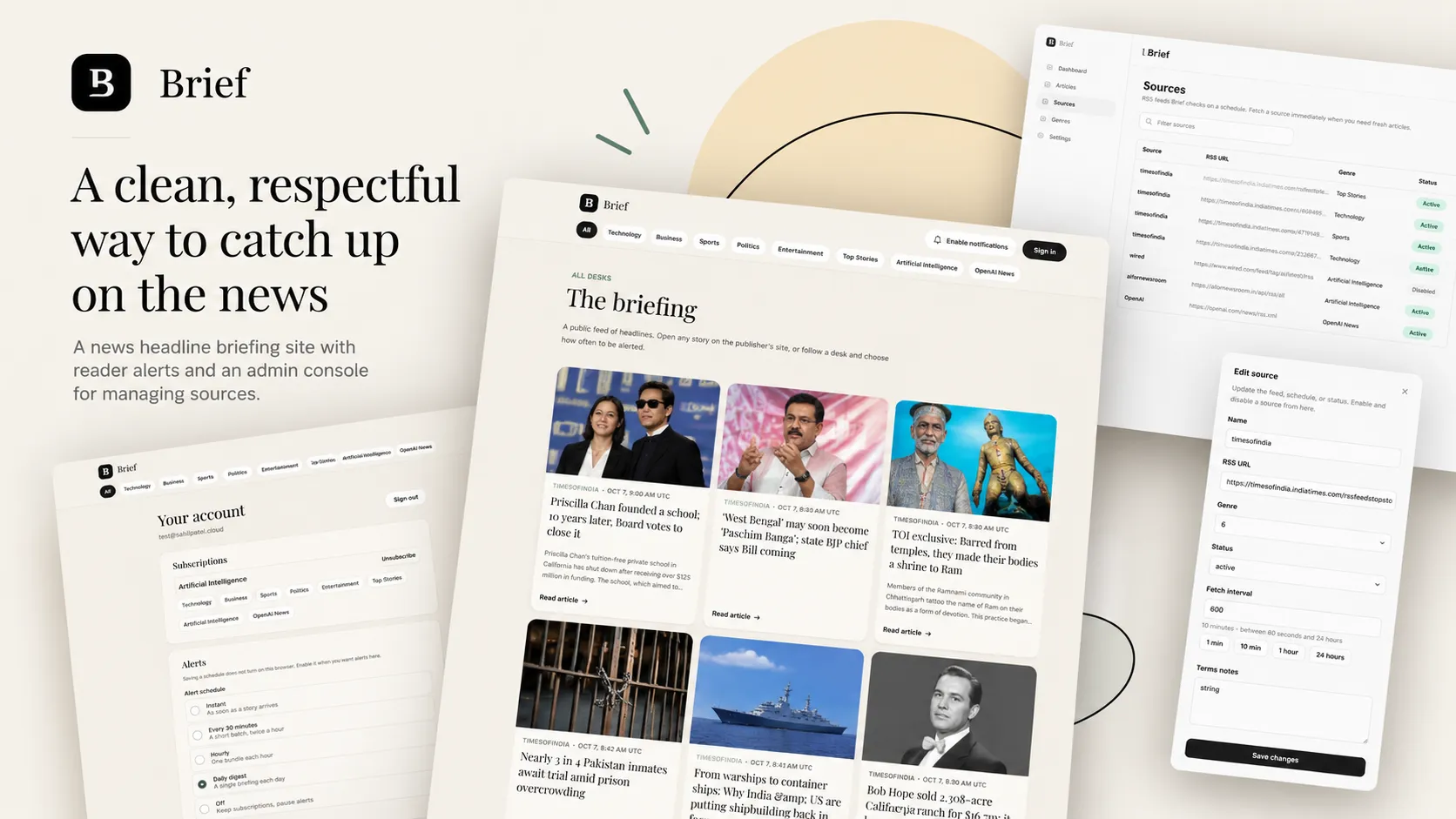
Brief gathers headlines from many news sources into one simple place. Readers scan what matters to them, choose how often they want to be alerted, and click through to the publisher to read the full story.
At a Glance
| What it is | A news headline briefing site, with a back-office tool for the team that runs it |
| Who it’s for | Readers who want a short list of headlines, and operators who manage the news sources behind it |
| What it includes | A public reading site, reader accounts with alert preferences, and a private admin console |
| Core promise | Headlines here. Full articles on the publisher’s own site. |
The Challenge
News is everywhere, and most of it comes with noise.
- Readers who only want a quick list of headlines often land on pages crowded with reprinted articles.
- Publishers share their feeds under specific terms, and those terms often cover showing a headline and short summary, not hosting the entire story.
- Alerts can easily turn into spam if every new story sends its own message.
- Behind the scenes, news sources break, change, or disappear. Someone has to notice, and the system should not keep retrying a dead source forever.
Brief was built to solve these problems together: a focused reading experience that respects publishers, keeps readers in control, and is easy to run.
The Solution
Brief collects the short summaries that publishers already offer through their public feeds and presents them in a tidy, easy-to-scan layout.
Each story shows:
- The headline
- A short description (cleaned up and capped at 500 characters)
- The source name
- An image, when the publisher provides one
- A clear link to read the full article on the publisher’s website
Brief never stores or displays the full text of an article. Every “Read” button sends the reader to the original publisher.
How It Works
1. Collect. The platform checks each news source on its own schedule and picks up new headlines automatically.
2. Tidy up. Summaries are cleaned of formatting clutter and trimmed to a short, readable length. Duplicate stories are recognized and skipped.
3. Organize. Each story is placed in a genre, such as Technology, Business, Sports, Politics, or Entertainment. Admins can add more genres at any time.
4. Share. Readers browse the latest headlines, filter by genre, and click through to the publisher.
5. Alert. Readers who sign up choose the genres they care about and how often they want to hear about new stories.
Key Features
For Readers
- A simple front page. Browse all headlines or open a single genre. Stories are shown 12 to a page.
- No account needed to read. Anyone can browse freely.
- Follow the genres you care about. Choose one or many.
- Pick your alert schedule. Instant, every 30 minutes, hourly, a daily digest, or off. Turning alerts off does not delete your follows.
- Sign up without losing your place. If you choose genres and a schedule before signing in, Brief remembers your choices and saves them once you’re signed up, even if you sign in through Google or Apple.
- Sign in your way. Email and password, plus Google sign-in. Apple sign-in is available in the built-in demo version of the reader.
- Browser notifications. In the built-in demo version, readers can enable notifications in their browser. The page also explains the extra steps needed on iPhones and iPads.
- Easy to find online. Every article page is built to be understood by search engines and to look good when shared on social media.
For Operators
A private admin console lets the team behind the site:
- Add and edit news sources. Set the feed address, genre, how often to check (from every minute up to once a day), and a note about the source’s terms of use.
- Fetch on demand. Pull in the latest stories from a source immediately.
- Create genres. Add new topics as the site grows.
- See what’s healthy. An overview shows total articles, source counts, and any sources that have stopped working.
- Browse articles. Review what readers are seeing.
- Choose a look. Light, dark, or system theme.
The admin console is protected by a private access token, so only authorized people can use it.
Built to Respect Publishers
Respect for the people who create the news is built into the product, not added as an afterthought.
- Summaries only. The system has no place to store a full article, so it can’t republish one by accident.
- Always credited and linked. Every story names its source and links to the original page.
- Terms on record. Each source has a notes field where the team can record its license or terms of use.
- Automated checks. The project’s tests confirm that full article text never appears in what readers see.
Built to Be Dependable
- Automatic pause for broken sources. If a news source keeps failing (five times in a row by default), Brief stops checking it and flags it for review. An admin can switch it back on once it is fixed.
- No duplicate stories. Checking the same source twice doesn’t create repeat headlines.
- No alert overload. Alerts are bundled into a single message per person, not one per story. Each person also has a daily limit (50 by default).
- Alerts that check themselves. When someone sets up an alert destination, Brief sends a test message first. If the destination keeps failing later, it is switched off automatically.
- Fast pages. Headlines are prepared on the server and remembered briefly, so pages load quickly for everyone.
Privacy and Security
- Passwords are stored in a protected, scrambled form, never in plain text.
- Sign-in sessions are short-lived and renew securely.
- Repeated sign-in attempts are limited to guard against guessing.
- Personal pages are never stored in shared caches.
- Alert destinations must use secure connections.
- The admin console requires a private token.
Alert Options
The platform can send alerts to the places people already use:
- ntfy
- Discord
- Slack
- Telegram
Messages are formatted for each service, and Discord and Slack alerts show up to 10 stories at a time.
Business Value
- Keeps readers focused. A short, scannable list helps people catch up in minutes.
- Protects relationships with publishers. Headlines drive readers to the source instead of replacing it.
- Reduces manual work. New stories arrive on their own, duplicates are handled automatically, and broken sources are flagged for you.
- Puts readers in charge. People choose their topics and how often they hear from you.
- Scales with your content. Add genres and sources as your coverage grows.
- Ready to be found. Search-friendly pages and an automatically generated site index help readers discover the site.
What’s Been Delivered
- A public reading site with a home feed, genre pages, and article pages
- Reader accounts with genre follows and alert schedules
- A private admin console for sources, genres, and article browsing
- An automatic news-collection and alert system that runs in the background
- Alerts to ntfy, Discord, Slack, and Telegram
- A test suite covering the core behavior of collecting, de-duplicating, and alerting
Technology at a Glance
Brief is made up of three connected parts:
- The reading site. Fast, search-friendly pages for the public.
- The engine. Collects stories, stores them, and sends alerts.
- The admin console. A separate, private dashboard for the team.
These are built with widely used, well-supported tools: Python, Astro, Next.js, PostgreSQL, and Redis.
Start a project If you need a focused, publisher-friendly way to put information in front of your audience, we'd love to talk. We can build content briefings, curated feeds, alert systems, and the admin tools to run them.Want Something Like This?